
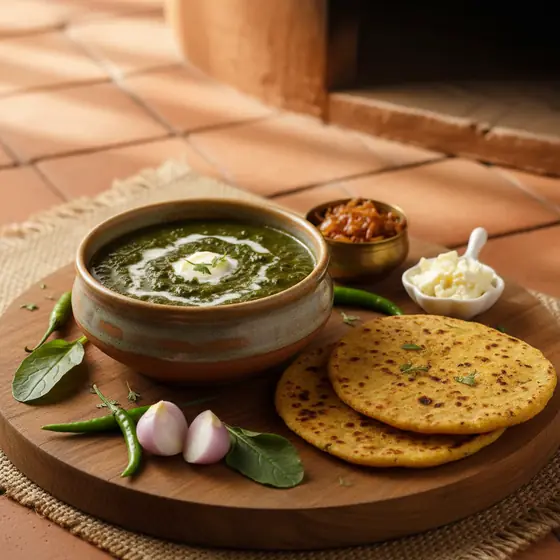
Some foods are good all year. Sarson ka saag and makki ki roti are not. They belong to winter, and that is exactly what makes them special. Once the temperature drops in Noida, this is the meal half our customers start asking about.
What is sarson ka saag, really?
Sarson ka saag is a Punjabi dish of mustard greens cooked slowly with other winter greens, usually spinach and bathua, then mashed and finished with a tempering of ginger, garlic, green chilli and onion. A spoon of makki atta (maize flour) is often stirred in to give it body.
The key word is slow. Proper saag is cooked for a long time until the greens break down into a thick, silky, slightly bitter, deeply savoury mash. Rushed saag tastes like boiled spinach. Patient saag tastes like a village kitchen in Punjab.
What makes makki ki roti authentic
Makki ki roti is made from maize flour, which has no gluten, so it cracks easily. That is why it is traditionally patted by hand, not rolled, and cooked on a tawa until spotted and firm. It is denser and slightly sweet compared to wheat roti, and it is designed to soak up saag and butter.
Signs of a good one:
- Thick but not raw in the middle
- A slightly grainy, rustic texture
- Golden spots on both sides
- Served hot, because makki roti hardens as it cools
At our kitchen, the makki is stone-ground and every roti is hand-patted, the way it has always been done.
The perfect winter plate
The classic combination is simple: saag + makki ki roti + white butter or ghee + something cool. Here is how to build it:
| Part | Classic choice | Our menu |
|---|---|---|
| Greens | Sarson ka saag | Saag, ₹119 |
| Bread | Makki ki roti | Makki Ki Roti, ₹35 each |
| Stuffed twist | Mooli or gobhi makki roti | 2 Muliwali Makki Ki Roti, ₹79 |
| Something cool | Seasonal raita | Bathua Raita, ₹119 |
| The full set | Everything together | Winter Arc Thaali, ₹438 |
The Winter Arc Thaali gives you Saag, 2 Makki Roti and 2 Methi Paratha with Bathua Raita, which is the whole winter experience in a single order. Because it is over ₹500 once you add a side, the 15% discount kicks in automatically.
Other winter specials worth trying
Winter is the best season for North Indian food, because so many greens are only available now:
- Methi Paratha with Bathua Raita: fresh fenugreek in the dough, cooled down with a raita made from bathua greens. Lighter than a stuffed paratha.
- Muliwali Makki Ki Roti: maize roti with grated radish inside, a very Punjabi village-style twist.
- Gobhi Wali Makki Ki Roti: maize roti stuffed with spiced cauliflower.
- Gobhi Paratha: winter cauliflower is at its sweetest, which makes this the best season for it.
Why you should eat seasonally (even in a city)
Eating with the season is how Indian home cooking has always worked. Winter greens are fresher, tastier and cheaper in winter, and heavier, warming foods like saag with ghee make sense when it is cold. Living in a city like Noida does not mean you have to give that up. It just means you need a kitchen that still cooks by the calendar.
Order sarson ka saag and makki ki roti in Noida
Our winter menu is live now. Open the menu, add the Winter Arc Thaali or build your own plate, and send the order on WhatsApp in one tap. You can also order from our Zomato listing. Same Noida kitchen as Swaadisht, same recipes.
FAQs
When is sarson ka saag in season?
Mustard greens are a winter crop in North India, so sarson ka saag is traditionally eaten from roughly November to February, when the greens are at their freshest.
Can I order sarson ka saag and makki ki roti in Noida?
Yes. Rasoi.exe in Noida serves Saag (₹119), Makki Ki Roti (₹35 each) and the Winter Arc Thaali with Saag, 2 Makki Roti and 2 Methi Paratha with Bathua Raita (₹438). Order on WhatsApp through rasoiexe.in or on Zomato.
Is sarson ka saag healthy?
Saag is made mostly from leafy greens such as mustard, spinach and bathua, so it is rich in fibre and greens. Makki roti is made from maize flour. The richness depends on how much butter or ghee is added on top.
What goes well with makki ki roti besides saag?
Makki roti also pairs well with dal makhani, a tangy raita, or jaggery and white butter as a simple winter treat.

